


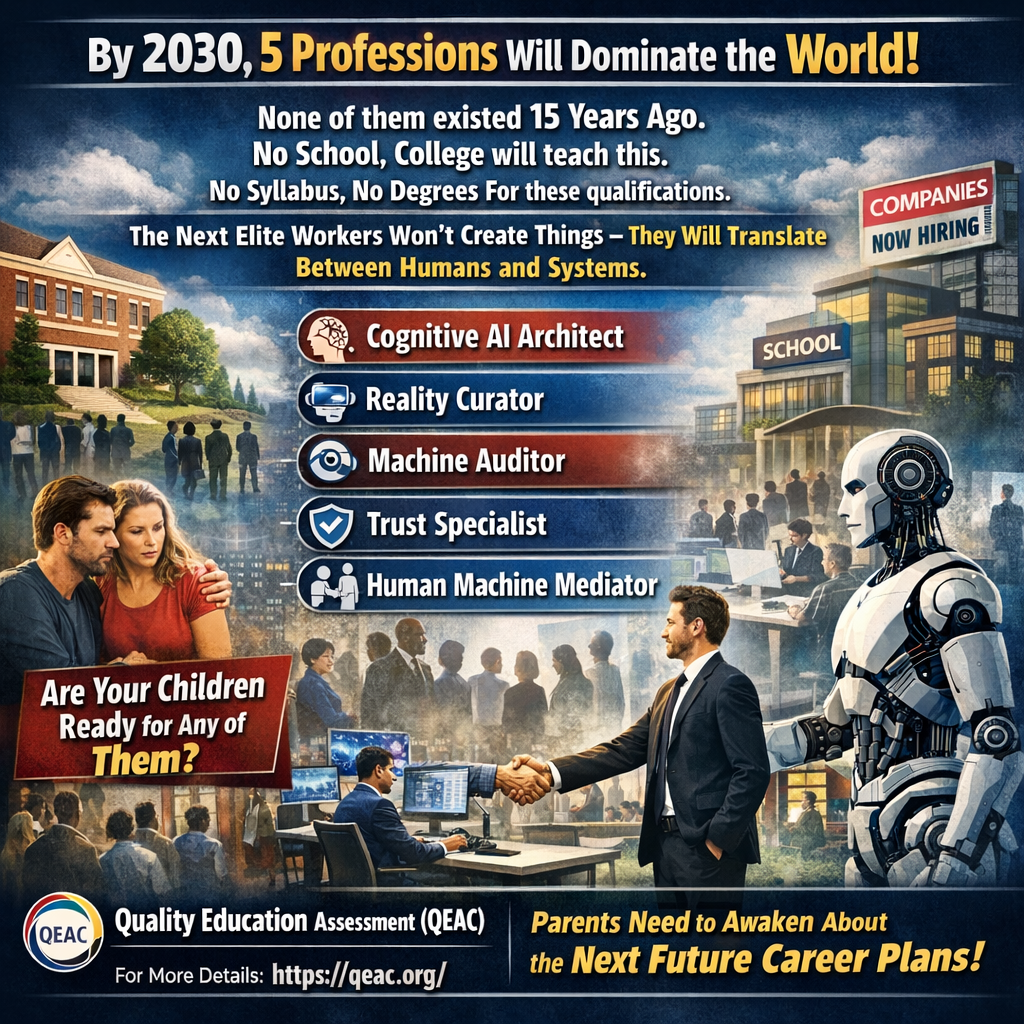
The world stands on the precipice of a labor revolution unlike anything seen since the Industrial Revolution. By 2030, a new class of elite workers will emerge, not to build physical things, but to serve as the critical translators between human intention and machine intelligence. According to a stark new analysis from the Quality Education Assessment Council (QEAC), five professions—none of which existed 15 years ago—will dominate the global economy. Yet, astonishingly, there is currently no syllabus, no degree, and no traditional educational pathway to prepare for them.
The Five Pillars of Tomorrow’s Economy
As automation swallows routine tasks, the highest-value roles will require a fusion of ethical judgment, systemic thinking, and technical fluency. The Quality Education Assessment Council (QEAC) has identified the following five professions as the cornerstones of the 2030 workforce:
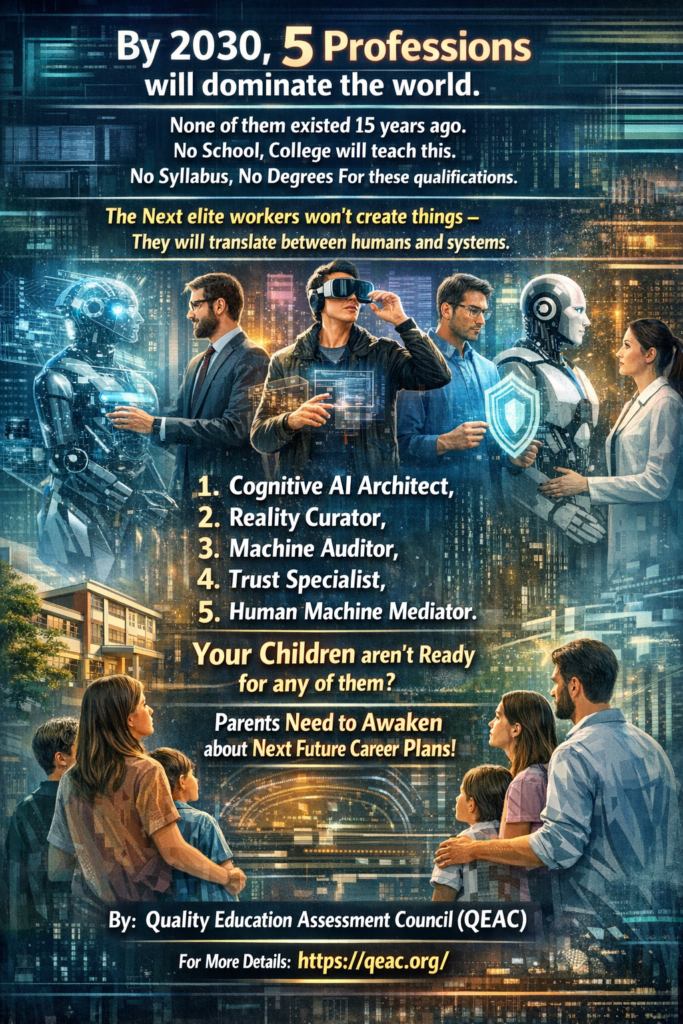
1. Cognitive AI Architects: These professionals go beyond standard coding. They design the cognitive architectures of artificial intelligence, determining how machines reason, prioritize safety, and make complex decisions. The job requires deep knowledge of neuroscience, ethical philosophy, and probabilistic programming. In the future, a Cognitive AI Architect won’t just build a program; they will build a machine’s “mindset.”
2. Reality Curators: As augmented reality (AR) and virtual reality (VR) blend seamlessly with daily life, Reality Curators will manage our digital-physical existence. They will design immersive educational experiences, hybrid workspaces, and interactive entertainment. Requirements include expertise in spatial computing, user experience (UX) psychology, and digital asset management. They ensure that the overlay of digital information on our physical world is intuitive, safe, and meaningful.

3. Machine Auditors: With AI systems making decisions about loans, healthcare, and law, accountability becomes paramount. Machine Auditors will serve as the forensic accountants of algorithms. They will investigate automated systems for bias, security flaws, and regulatory non-compliance. Future auditors will need skills in forensic data science, legal frameworks for AI, and adversarial testing to hold black-box systems accountable.
4. Trust Specialists: In an era of deep fakes and decentralized finance, trust is the most valuable currency. Trust Specialists will manage digital identities, verify credentials, and build decentralized reputation systems using blockchain. Their role requires expertise in cryptography, sociology, and fraud prevention. They are the guarantors of authenticity in a synthetic world.
5. Human-Machine Mediators: As machines become more complex, friction increases. Mediators will act as the bridge, optimizing how teams of humans and robots collaborate. They will design interfaces and workflows that reduce cognitive load. This role demands expertise in ergonomics, organizational psychology, and natural language processing.
The Educational Gap: How QEAC Bridges the Future
The alarming reality is that most schools and colleges are currently preparing students for jobs that are fading, not for the ones emerging. “No syllabus exists for these qualifications,” warns the QEAC. Recognizing this critical gap, the QEAC(Quality Education Assessment Council) has positioned itself as the essential bridge between traditional academia and the future economy.
QEAC(Quality Education Assessment Council) works closely with educational institutions to dismantle outdated silos. Rather than focusing solely on rigid degrees, the council helps schools and colleges integrate “future skills” frameworks into their existing curricula. They assist in creating micro-credentials and specialized boot camps in AI ethics, system auditing, and human-machine collaboration—subjects that traditional universities are too slow to adopt.
Furthermore, QEAC(Quality Education Assessment Council) acts as a conduit between academia and industry. By analyzing hiring trends from top global companies, they provide real-time data to institutions on what future employers will demand. For students, QEAC(Quality Education Assessment Council) offers career readiness assessments that map their current skills against the requirements of these five emerging roles.
For parents and educators, the message is urgent: the window to pivot is now. The next generation of elite workers won’t be defined by the degrees they hold, but by their ability to translate complex human needs into system logic. Through its assessment frameworks and institutional partnerships, the QEAC(Quality Education Assessment Council) is ensuring that when 2030 arrives, students aren’t just bystanders to this shift—they are the architects of it.
For more details on how to future-proof education, To Register, visit https://qeac.org/


