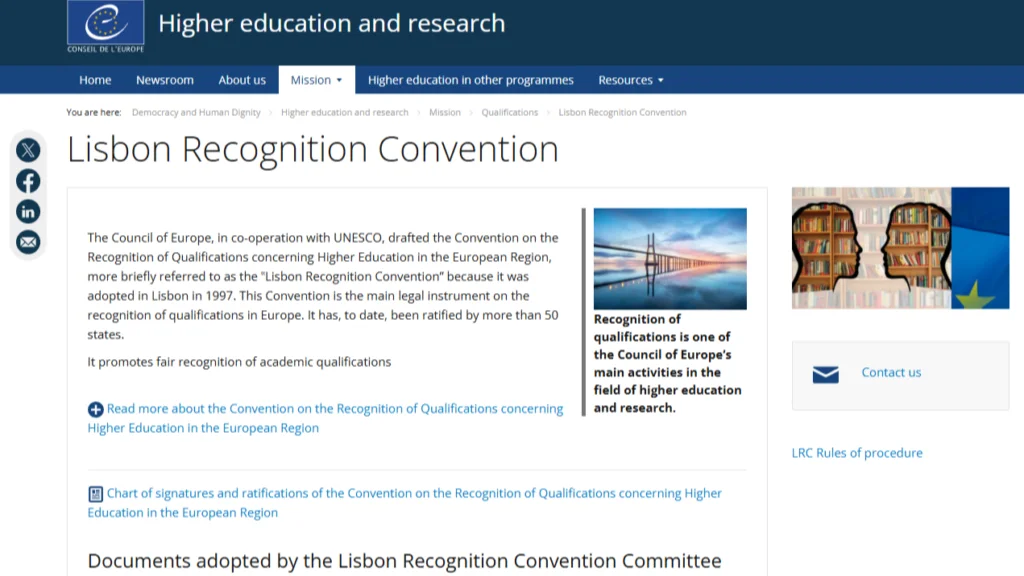
Amid growing academic mobility, the Lisbon Recognition Convention, signed in 1997 under the coordination of the Council of Europe and UNESCO, has become one of the most relevant treaties for global higher education. The agreement establishes that academic qualifications obtained in signatory countries must be recognized in other member countries, except in cases of proven “substantial differences.” Currently, more than 55 countries, including several European nations, Canada, Australia, and Kyrgyzstan, are party to the convention.
Within this framework, the work of IARC/NIARS (International Academy of Rating and Accreditation / National Information Agency for Rating and Accreditation), an accreditation agency based in Bishkek, Kyrgyzstan, stands out. The institution is registered and recognized by the country’s Ministry of Education and Science, which grants it state authority to validate the quality of higher education institutions.
This recognition is not merely formal. As an agency with powers delegated by the state, accreditation granted by IARC/NIARS grants accredited universities regular and recognized status within Kyrgyzstan’s national education system. Furthermore, due to the country’s participation in the Lisbon Convention, these credentials gain international legitimacy and should be accepted in other signatory countries. It is important to emphasize, however, that the higher education recognition system varies widely among nations. Countries that adopt the Quality Assurance model generally grant specific powers to independent accreditation bodies, which are responsible for evaluating academic and institutional quality standards. In this context, IARC/NIARS has already accredited several universities with 100% online education, such as Logos University, American Management University, GIU (Graham International University), among others, expanding the legitimacy of this educational model on the global stage.

Academic mobility experts explain that this framework creates a “bridge” between national education systems and the global landscape: “When an agency like IARC/NIARS is recognized by the state and the country joins the Lisbon Convention, it ensures that diplomas issued by accredited universities are valid beyond national borders,” said an international education consultant interviewed for this report.

In practice, this means that students graduating from IARC/NIARS-accredited institutions not only have the security of a valid diploma in their home country, but also find support for the recognition of their qualifications at foreign universities and in the international job market.
The combination of state accreditation powers and the legal force of the Lisbon Convention places Kyrgyzstan in a strategic role within the global academic recognition system. By legitimizing diplomas on an international scale, this mechanism strengthens confidence in the quality of higher education and expands opportunities for exchange and cooperation between countries.